Thursday, July 18, 2019

No.31
ARRIVING IN THE LAND OF PROMISE
Charles Frederick Ulrich 1858-98


-o0o-

MY FRIEND LEONARD


I met Leonard Lewis 1927-2005 at RAF Brize Norton in Oxfordshire where we were both doing our National Service. We soon became friends for we shared a keen interest in all things connected with entertainment. We joined the station concert party where he was a jack-of-all trades and I provided the music. For one of our shows we had the professional assistance of Ralph Reader the founder-producer of the Scout Gang Show. He was on our station planning that year’s RAF Pageant at Olympia.

One of our cast was a civilian worker Bunny Shayler, a comedian who had his own small group of entertainers outwith the RAF. Leonard and I joined them and we did quite a number of shows around Oxfordshire. I remember going to one village in the wilds where, on our arrival at the hall, Bunny was greeted with “Are you the man from the BBC?” (He rather traded on the fact that he had once been on BBC Midland Children’s Hour). Not long afterwards though, he appeared on radio in Hughie Green’s “Opportunity Knocks”, and I was one of his supporters who accompanied him to the live broadcast in the Paris Cinema, London.

This is a photo of Leonard with me taken sometime in the late 1950s. 


After demob Leonard worked in rep at Morecambe and Ashton-under-Lyne before going to the Library Theatre, Manchester. I met up with him again when he came to Glasgow to join the BBC as a TV production assistant. He and his wife Jean and their three little girls came to live in Lenzie and our two families got on well together.
In 1963 his work took him back to England, and his family followed of course. From then on, his name appeared regularly in Radio Times as director or producer of Z Cars, Softly, Softly, When The Boat Comes In, The Good Companions, Flambards and others. Before he retired, he was executive producer of the longrunning BBC soap “Eastenders”.
I must mention that the playwright Alan Plater wrote a very fitting obituary which appeared in the Guardian on 11th January 2006.

This is a photo I took of Leonard and Jean at their home in Somerset.


When I think of the RAF Concert Party, I always remember Leonard on stage, dressed as a butler, reciting this monologue -

A lady to see you, Mr. Archibald, sir.
The matter appears to be pressing.
Luncheon was served quite an hour ago,
I didn’t awaken you, sir, as you know.
There are times, sir, when sleep is a blessing.
I have here some ice, sir, to put on your head,
And also a whisky and 'polly'.
I don't know what time you retired to bed,
But the party sir, must have been jolly…
…If you'll pardon my saying so.

The lady in question a-waiting below,
Is accompanied, sir, by her mother,
And also a prize-fighting gentleman, sir,
A pugnacious character one might infer,
Whom the lady describes as her brother.
The elderly female is quite commonplace,
A most vulgar person, I fear, sir,
Who shouts in a nerve wracking falsetto voice,
And her language is painful to hear, sir…
…If you'll pardon my saying so.

The prize-fighter person is burning with hate.
He refers to you, sir, as a 'twister.'
He threatens to alter the shape of your 'clock,'
To break you in half, sir, and knock off your 'block,'
Unless you do right by his sister.
The young lady says, sir, with trembling lips,
That you made her a promise of marriage.
She wants to know why she should eat fish and chips,
While you, sir, ride by in your carriage…
…If you'll pardon my saying so.

Sir John has a dreadful attack of the gout,
He is fuming to beat all creation.
My lady, your mother, is up in the air.
She is having hysterics and tearing her hair,
And borders on nervous prostration.
Would you wish me to pack your portmanteau at once,
And look up the times of the trains, sir?
Or perhaps you would rather I brought you a drink
And a pistol to blow out your brains, sir?
...If you'll pardon my saying so.


-o0o-

THE DOCTOR
Luke Fildes 1843-1927
Nationality - English


-o0o-

I OPENED A BOOK
Julia Donaldson b.1948

I opened a book and in I strode.
Now nobody can find me.
I've left my chair, my house, my road,
My town and my world behind me.
I'm wearing the cloak, I've slipped on the ring,
I've swallowed the magic potion.
I've fought with a dragon, dined with a king
And dived in a bottomless ocean.
I opened a book and made some friends.
I shared their tears and laughter
And followed their road with its bumps and bends
To the happily ever after.
I finished my book and out I came.
The cloak can no longer hide me.
My chair and my house are just the same,
But I have a book inside me.

-o0o-


Photo thanks to Prexels.com

-o0o-


Three Poems by Thomas Hardy


SONG TO AN OLD BURDEN

The feet have left the wormholed flooring, 
That danced to the ancient air, 
The fiddler, all-ignoring, 
Sleeps by the gray-grassed 'cello player: 
Shall I then foot around around around, 
As once I footed there! 

The voice is heard in the room no longer 
That trilled, none sweetlier, 
To gentle stops or stronger, 
Where now the dust-draped cobwebs stir: 
Shall I then sing again again again, 
As once I sang with her! 

The eyes that beamed out rapid brightness 
Have longtime found their close, 
The cheeks have wanned to whiteness 
That used to sort with summer rose: 
Shall I then joy anew anew anew, 
As once I joyed in those! 

O what's to me this tedious Maying, 
What's to me this June? 
O why should viols be playing 
To catch and reel and rigadoon? 
Shall I sing, dance around around around, 
When phantoms call the tune!

-o0o-

SHE DID NOT TURN

She did not turn,
But passed foot-faint with averted head
In her gown of green, by the bobbing fern,
Though I leaned over the gate that led
From where we waited with table spread;
But she did not turn:
Why was she near there if love had fled?

She did not turn,
Though the gate was whence I had often sped
In the mists of morning to meet her, and learn
Her heart, when its moving moods I read
As a book she mine, as she sometimes said;
But she did not turn,
And passed foot-faint with averted head.

-o0o-

THE BEAUTY

O do not praise my beauty more,
In such word-wild degree,
And say I am one all eyes adore;
For these things harass me!

But do for ever softly say:
"From now unto the end
Come weal, come wanzing, come what may,
Dear, I will be your friend."

I hate my beauty in the glass:
My beauty is not I:
I wear it: none cares whether, alas,
Its wearer live or die!

The inner I O care for, then,
Yea, me and what I am,
And shall be at the gray hour when
My cheek begins to clam.

-o0o-

THE MUSIC LESSON
Lord Frederick Leighton 1830-96


-o0o-

Thursday, July 11, 2019

No.30
STILL LIFE WITH FRUIT
1869
Claude Monet
1840-1926
Nationality - French


-o0o-

THE BRIGHT FIELD
R.S. Thomas

I have seen the sun break through
to illuminate a small field
for a while, and gone my way
and forgotten it. But that was the
pearl of great price, the one field that had
treasure in it. I realise now
that I must give all that I have
to possess it. Life is not hurrying

on to a receding future, nor hankering after
an imagined past. It is the turning
aside like Moses to the miracle
of the lit bush, to a brightness
that seemed as transitory as your youth
once, but is the eternity that awaits you.

-o0o-


This is typical view of what became known as “Miners’ Rows.”

One part of the village where I live consists of former miners’ houses. Nowadays they’re all privately-owned, and most have extensions, conservatories added at the rear or additional rooms built in the attic space.

My great-grandfather George was a miner. He died long before I was born, but I remember the area in which he lived. The pit houses of his day are long gone of course; many would consist of just a room and a kitchen, and with big families common then would certainly be overcrowded.

Later my grandfather, who worked in the pit, first as a train driver and then as a power station attendant, lived in one of those houses.

People were lucky if they had an inside toilet. Often outside toilets had to be shared with other families, and sometimes they were situated at a distance from the house. Not good if a visit during the night was needed!!!

A few miners were fortunate in having electricity laid on from the pit. Electricity didn’t come to general housing till much later. It wasn’t till 1936, when my father bought his own house, that I lived in a place where the flick of a switch lit up a room.

-o0o-

THE ARTIST'S MOTHER
1896
Pastel on Paper
Pablo Picasso
1881-1973


-o0o-

TOMORROW
Dennis O'Driscoll
1954-2012

I
Tomorrow I will start to be happy.
The morning will light up like a celebratory cigar.
Sunbeams sprawling on the lawn will set
dew sparkling like a cut-glass tumbler of champagne.
Today will end the worst phase of my life.

I will put my shapeless days behind me,
fencing off the past, as a golden rind
of sand parts slipshod sea from solid land.
It is tomorrow I want to look back on, not today.
Tomorrow I start to be happy; today is almost yesterday.

II
Australia, how wise you are to get the day
over and done with first, out of the way.
You have eaten the fruit of knowledge, while
we are dithering about which main course to choose.
How liberated you must feel, how free from doubt:

the rise and fall of stocks, today’s closing prices
are revealed to you before our bidding has begun.
Australia, you can gather in your accident statistics
like a harvest while our roads still have hours to kill.
When we are in the dark, you have sagely seen the light.

III
Cagily, presumptuously, I dare to write 2018.
A date without character or tone. 2018.
A year without interest rates or mean daily temperature.
Its hit songs have yet to be written, its new-year
babies yet to be induced, its truces to be signed.

Much too far off for prophecy, though one hazards
a tentative guess - a so-so year most likely,
vague in retrospect, fizzling out with the usual
end-of-season sales; everything slashed:
your last chance to salvage something of its style.

-o0o-

Trees are
always a relief, 
after people
-David Mitchell


-o0o-

TWO KINDS OF PEOPLE
Ella Wheeler Wilcox 
1850-1919

There are two kinds of people on earth to-day;
Just two kinds of people, no more, I say.
Not the sinner and saint, for it's well understood,
The good are half bad, and the bad are half good.

Not the rich and the poor, for to rate a man's wealth,
You must first know the state of his conscience and health.
Not the humble and proud, for in life's little span,
Who puts on vain airs, is not counted a man.

Not the happy and sad, for the swift flying years
Bring each man his laughter and each man his tears.
No - the two kinds of people on earth I mean,
Are the people who lift, and the people who lean.

Wherever you go, you will find the earth's masses,
Are always divided in just these two classes.
And oddly enough, you will find too, I ween,
There's only one lifter to twenty who lean.

In which class are you? Are you easing the load,
Of overtaxed lifters, who toil down the road?
Or are you a leaner, who lets others share
Your portion of labour, and worry and care?

-o-0-o-

THE WINDOW
Alhed Larsen
1872-1927
Nationality - Danish


-o0o-


Photo thanks to Pexels

-o0o-

MISS FOGARTY'S HOME BAKED CAKE
Anon

As I sat in my window last evening,
The postman brought in to me
A little gilt-edged invitation sayin':
"Gilhooley, come over to tea."
I knew that the Fogarties sent it.
So I went, just for old friendship's sake.
The first thing they gave me to tackle
Was a slice of Miss Fogarty's cake.

There were plums and prunes and cherries.
There were citrons and raisins and cinnamon, too
There was nutmeg, cloves and berries,
And a crust that was nailed on with glue.
There were caraway seeds in abundance,
Such that work up a fine stomach ache
That could kill a man twice after eating a slice
Of Miss Fogarty's home baked cake.

Miss Mulligan wanted to try it.
But, really, it wasn't no use,
For we worked in it over an hour,
And we couldn't get none of it loose
Till Murphy came in with a hatchet
And Kelly came in with a saw.
That cake was enough, by the powers above,
For to paralyse any man's jaw.

Miss Fogarty, proud as a peacock,
Kept smiling and blinking away
Till she flipped over Flanagan's brogans.
And she spilt the home brew in her tea.
"Aye, Gilhooley," she says "you're not eatin'.
Try a little bit more, for me sake."
And "No, Miss Fogarty," says I,
"For I've had quite enough of your cake."

Maloney was took with the colic.
O'Donald, a pain in his head.
McNaughton lay down on the sofa,
And he swore that he wished he was dead.
Miss Bailey went into hysterics,
And there she did wriggle and shake.
And everyone swore they were poisoned
Just from eating Miss Fogarty's cake. 

-o0o-

SWAMP SUNSET
Harold Rudolph
1850-83
Nationality - American


-o0o-

UPDATED EVERY WEEKEND
-o=0=o-


Thursday, July 4, 2019

No.29

“She was sitting in a garden more beautiful than even her rampaging imagination could ever have conjured up; she was being serenaded by trees.” Lynn Kurland


-o0o-

The Sayings of Lao-Tsu

Live a simple life, be free, be yourself and be close to nature.
Do these things and you will be wise and happy

-o0o-


THE SIESTA
1892-4
Oil on Canvas
88.9 cm x 116.2 cm
Paul Gauguin
1848-1903
Nationality - French

-o0o-


Three Poems by Thomas Hardy

A HOUSE WITH A HISTORY

There is a house in a city street
   Some past ones made their own;
Its floors were criss-crossed by their feet,
      And their babblings beat
   From ceiling to white hearth-stone.

And who are peopling its parlours now?
   Who talk across its floor?
Mere freshlings are they, blank of brow,
      Who read not how
   Its prime had passed before

Their raw equipments, scenes, and says
   Afflicted its memoried face,
That had seen every larger phase
      Of human ways
   Before these filled the place.

To them that house's tale is theirs,
   No former voices call
Aloud therein.  Its aspect bears
      Their joys and cares
alone from wall to wall.


-o0o-

A TWO-YEARS' IDYLL

Yes; such it was;
   Just those two seasons unsought,
Sweeping like summertide wind on our ways;
      Moving, as straws,
   Hearts quick as ours in those days;
Going like wind, too, and rated as nought
   Save as the prelude to plays
   Soon to come--larger, life-fraught:
      Yes; such it was.

      "Nought" it was called,
   Even by ourselves--that which springs
Out of the years for all flesh, first or last,
      Commonplace, scrawled
   Dully on days that go past.
Yet, all the while, it upbore us like wings
   Even in hours overcast:
   Aye, though this best thing of things,
      "Nought" it was called!

      What seems it now?
   Lost:  such beginning was all;
Nothing came after:  romance straight forsook
      Quickly somehow
   Life when we sped from our nook,
Primed for new scenes with designs smart and tall, 
  A preface without any book,
   A trumpet uplipped, but no call;
that seems it now

   -o0o-

WAGTAIL AND BABY

A baby watched a ford, whereto
A wagtail came for drinking;
A blaring bull went wading through,
The wagtail showed no shrinking.

A stallion splashed his way across,
The birdie nearly sinking;
He gave his plumes a twitch and toss,
And held his own unblinking.

Next saw the baby round the spot
A mongrel slowly slinking;
The wagtail gazed, but faltered not
In dip and sip and prinking.

A perfect gentleman then neared;
The wagtail, in a winking,
With terror rose and disappeared;
The baby fell a-thinking.

-o0o-

DREAMING DAISY
Sophie Anderson
1823-1903


-o0o-

SHALL I COMPARE THEE TO A SUMMER’S DAY?
William Shakespeare 1564-1616

Shall I compare thee to a summer's day?
Thou art more lovely and more temperate.
Rough winds do shake the darling buds of May,
And summer's lease hath all too short a date.
Sometime too hot the eye of heaven shines,
And often is his gold complexion dimmed;
And every fair from fair sometime declines,
By chance, or nature's changing course, untrimmed;
But thy eternal summer shall not fade,
Nor lose possession of that fair thou ow'st,
Nor shall death brag thou wand'rest in his shade,
When in eternal lines to Time thou grow'st.
     So long as men can breathe, or eyes can see,
     So long lives this, and this gives life to thee.

-o0o-

A young offender is apprehended by a London policeman in Trafalgar Square in August 1919


-o0o-

I REMEMBER when I was very small I was afraid of the black-faced coalman who used to tease me about a girl in the next close.

I REMEMBER the lamplighter with his long pole. I thought he had a great job.

I REMEMBER that every so often buskers would appear in our back-court and sing one or two songs. Housewives would open their windows, throw down coppers and the singer would move on to the next tenement. Sometimes one of them would play a tin whistle or do a dance, and I’m told that before the First World War German bands toured the country entertaining in back-courts.

I REMEMBER the horse-driven vans which visited our street, and the occasion when the horse which pulled the baker’s van fell down. Someone sat on its head as it lay flat on the street, while the baker undid all the belts and straps. Only when that was done was the animal able to get up, unharmed.

I REMEMBER message boys on bicycles. They were usually employed by food shops, and they had the job of delivering what housewives had ordered.

I REMEMBER that in the wintertime we went to school wrapped up in layers of clothing. Boys always wore caps and in those days we had to wait till we were 15 or 16 before we got long trousers.

I REMEMBER the old lady who lived in the top floor. It seemed to me that she always wore the same clothes, a long dress down to her ankles and a shawl. Half a dozen times a day she would climb down the stairs with an overweight Scotch terrier under her arm. She would let it wander around the back court for a few minutes and then struggle back up the stairs.

I REMEMBER seeing American comics for the first time. They were the size of broadsheet newspapers and had lots of pages. And the content was so different from our “Tiger Tim” and “The Rainbow.”

I REMEMBER that cigarette packets each contained a picture card. Many subjects were covered including sports personalities, film stars, dance band leaders, comedians, cars, locomotives, birds, animals, fish and more.

I REMEMBER that the best room or parlour in houses was used only on special occasions. That’s where the piano would be kept and the instrument was generally kept locked. (Did they keep it locked to prevent a burglar stealing the keys?)

I REMEMBER that, when drivers parked their cars on a hill (even on a slight hill), they would place a brick or a large stone at a front wheel to prevent the vehicle moving off by accident.

I REMEMBER that, at primary school, if there was torrential rain in the morning, the school would close at lunchtime and we got a half-holiday. In such weather the boys would cram into the playground shelter at the morning interval, stand up on the long wooden bench and stamp their feet in time to their repeated cry of “We want a hauf!” (a half-day)

Yes,this is me! My daughter named this photo "Happy Dad."

-o0o-

THE ASH GROVE
Anon

Down yonder green valley where streamlets meander,
When twilight is fading, I pensively rove,
Or at the bright noontide in solitude wander
Amid the dark shades of the lonely Ash grove.

'Twas there while the blackbird was joyfully singing,
I first met my dear one, the joy of my heart;
Around us for gladness the bluebells were ringing,
Ah! then little thought I how soon we should part.

Still grows the bright sunshine o'er valley and mountain,
Still warbles the blackbird his note from the tree;
Still trembles the moonbeam on streamlet and fountain,
But what are the beauties of nature to me.

With sorrow, deep sorrow, my bosom is laden,
All day I go mourning in search of my love.
Ye echoes, O tell me, where is the sweet maiden?
She sleeps 'neath the green turf down by the Ash grove.

-o0o-

LADY IN A GARDEN
Edmund Leighton 1853-1922


-o0o-

UPDATED EVERY WEEKEND

Thursday, June 27, 2019

No.28
THE RED BOAT WITH BLUE SAILS
Odilon Redon
1840-1916


-o0o-

THE PEOPLE UPSTAIRS
 Ogden Nash
1902-71

The people upstairs all practise ballet
Their living room is a bowling alley
Their bedroom is full of conducted tours.
Their radio is louder than yours,
They celebrate week-ends all the week.
When they take a shower, your ceilings leak.
They try to get their parties to mix
By supplying their guests with Pogo sticks,
And when their fun at last abates,
They go to the bathroom on roller skates.
I might love the people upstairs more
If only they lived on another floor.

-o0o-


The local clinic, which in my young day used to house the school doctor and school dentist, lay empty for some time and then was replaced by housing.

I presume that over the years the old building provided a full range of services for all age groups, but for me that was the place in which I had my tonsils removed.

In those days it was thought the tonsils were responsible for a lot of childish illnesses, and many parents were persuaded that having the tonsils out would benefit their young ones.

I don’t remember a great deal about my operation, but I know that, after the job was done, I stayed in the clinic overnight and then was allowed home.

My sister tells me that she was to have it done as well. However, our parents decided against it, after a little girl died having her tonsils out. (And since then, Rita’s tonsils have given her no trouble at all.) 

I was certainly more fortunate than some Glasgow children living in the early 1920s. Those attending the Victoria Infirmary had their tonsillectomies, were sent back to the waiting room to recover, and after a while went home with their mothers by tram. I’ve been told that these tramcars were known as the “Sawdust Cars,” because the floor had to be covered with sawdust to mop up the blood.

There was one good thing about having your tonsils out - you were allowed plenty of ice cream afterwards!

-o0o-

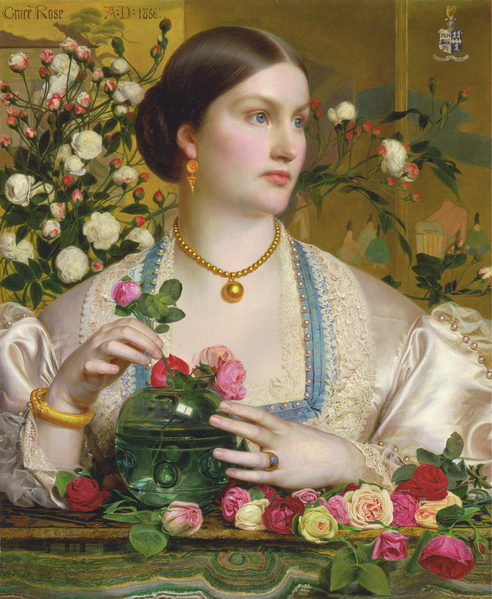
GRACE JONES
Frederick Sandys
1829-1904


-o0o-

"Careless, unsocial plant! that loves to dwell 
'Midst skulls and coffins, epitaphs and worms: 
Where light-heel'd ghosts and visionary shades, 
Beneath the wan, cold Moon (as Fame reports) 
Embodied, thick, perform their mystic rounds 
No other merriment, dull tree! is thine."
- Robert Blair (commenting on the Yew tree)


This is a part of the churchyard of St.Mary's, Painswick showing some of the famous yew trees. According to the legend, there are 99 yews there and the Devil has decreed that, if ever a 100th was planted, he would destroy it. In the year 2000 one was added to mark the millennium and it has survived.

-o0o-


Three Poems by Thomas Hardy

THE CLOCK-WINDER

It is dark as a cave,
Or a vault in the nave
When the iron door
Is closed, and the floor
Of the church relaid
With trowel and spade.

But the parish-clerk
Cares not for the dark
As he winds in the tower
At a regular hour
The rheumatic clock,
Whose dilatory knock
You can hear when praying
At the day's decaying,
Or at any lone while
From a pew in the aisle.

Up, up from the ground
Around and around
In the turret stair
He clambers, to where
The wheelwork is,
With its tick, click, whizz,
Reposefully measuring
Each day to its end
That mortal men spend
In sorrowing and pleasuring
Nightly thus does he climb
To the trackway of Time.

Him I followed one night
To this place without light,
And, ere I spoke, heard
Him say, word by word,
At the end of his winding,
The darkness unminding:-

"So I wipe out one more,
My Dear, of the sore
Sad days that still be,
Like a drying Dead Sea,
Between you and me!"

Who she was no man knew:
He had long borne him blind
To all womankind;
And was ever one who
Kept his past out of view.

-o0o-


ON A MIDSUMMER EVE

I idly cut a parsley stalk,
And blew therein towards the moon;
I had not thought what ghosts would walk
With shivering footsteps to my tune.

I went, and knelt, and scooped my hand
As if to drink, into the brook,
And a faint figure seemed to stand
Above me, with the bygone look.

I lipped rough rhymes of chance, not choice,
I thought not what my words might be;
There came into my ear a voice
That turned a tenderer verse for me.

-o0o-

ON A DISCOVERED CURL OF HAIR

When your soft welcomings were said,
This curl was waving on your head,
And when we walked where breakers dinned
It sported in the sun and wind,
And when I had won your words of grace
It brushed and clung about my face.
Then, to abate the misery
Of absentness, you gave it me.

Where are its fellows now? Ah, they
For brightest brown have donned a gray,
And gone into a caverned ark,
Ever unopened, always dark!

Yet this one curl, untouched of time,
Beams with live brown as in its prime,
So that it seems I even could now
Restore it to the living brow
By bearing down the western road
Till I had reached your old abode.

-o0o-

My Visit to the Kelpies at Falkirk


-o0o-

MAIOLICA BASKET OF FRUIT
Fede Galizia 
1578-1630


-o0o-


The Sayings of Lao-Tsu

Nature does not hurry
Yet everything is accomplished

-o0o-

FEASTING AND DANCING PEASANTS
Peter Paul Rubens
1577-1640


-o0o-

UPDATED EVERY WEEKEND

-o=0=o-

Thursday, June 20, 2019

No.27
BOWL OF FLOWERS
Slava Raskaj
1877-1906
Nationality - Croatian


-o0o-

ADLESTROP
Edward Thomas

Yes. I remember Adlestrop—
The name, because one afternoon
Of heat the express-train drew up there
Unwontedly. It was late June.

The steam hissed. Someone cleared his throat.
No one left and no one came
On the bare platform. What I saw
Was Adlestrop—only the name

And willows, willow-herb, and grass,
And meadowsweet, and haycocks dry,
No whit less still and lonely fair
Than the high cloudlets in the sky.

And for that minute a blackbird sang
Close by, and round him, mistier,
Farther and farther, all the birds
Of Oxfordshire and Gloucestershire.


-o0o-


The Sayings of Lao-Tsu

Water is the softest thing, yet it can penetrate mountains and earth.
This shows clearly the principle of softness overcoming hardness.

-o0o-

“A row of trees far away, there on the hillside.
But what is it, a row of trees? It’s just trees.
Row and the plural trees aren’t things, they’re names.” 

― Alberto Caeiro


-o0o-

Three Poems by Thomas Hardy

HER SECRET

That love's dull smart distressed my heart
He shrewdly learnt to see,
But that I was in love with a dead man
Never suspected he.

He searched for the trace of a pictured face,
He watched each missive come,
And a note that seemed like a love-line
Made him look frozen and glum.

He dogged my feet to the city street,
He followed me to the sea,
But not to the neighbouring churchyard
Did he dream of following me.

-o0o-

THE PHANTOM HORSEWOMAN

Queer are the ways of a man I know:
He comes and stands In a careworn craze, And looks at the sands And the seaward haze With moveless hands And face and gaze, Then turns to go... And what does he see when he gazes so? They say he sees as an instant thing More clear than to-day, A sweet soft scene That once was in play By that briny green; Yes, notes alway Warm, real, and keen, What his back years bring— A phantom of his own figuring. Of this vision of his they might say more: Not only there Does he see this sight, But everywhere In his brain–day, night, As if on the air It were drawn rose bright– Yea, far from that shore Does he carry this vision of heretofore:
A ghost-girl-rider. And though, toil-tried, He withers daily, Time touches her not, But she still rides gaily In his rapt thought On that shagged and shaly Atlantic spot, And as when first eyed Draws rein and sings to the swing of the tide.
-o0o-

OUTSIDE THE WINDOW

‘My stick!’ he says, and turns in the lane
To the house just left, whence a vixen voice
Comes out with the firelight through the pane,
And he sees within that the girl of his choice
Stands rating her mother with eyes aglare
For something said while he was there.

‘At last I behold her soul undraped!’
Thinks the man who had loved her more than himself;
‘My God!—'tis but narrowly I have escaped.—
My precious porcelain proves it delf.’
His face has reddened like one ashamed,
And he steals off, leaving his stick unclaimed.

-o0o-

NUDE IN DAPPLED SUNLIGHT
1915
Frederick Carl Frieseke
1874-1937
Nationality - American


-o0o-


Can you remember the last time a doctor looked down your throat and asked you to say Ah? Or held your wrist to feel your pulse? Or listened to your chest through his stethoscope?

When he had finished the examination, he would write out a prescription which you would present to the chemist. Invariably you would get a bottle of mixture with a horrible taste, specially concocted just for you!

In most homes there was a corner of a shelf in the kitchen where a selection of medicine bottles stood. Apart from those which had been prescribed in previous years, there would be essentials like Syrup of Figs, Emulsion, Malt and the dreaded Castor Oil!!!

For some children the cure for constipation was blackberries and for others raw or cooked onions.

It seems that a mixture of sulphur and treacle was given once a week to many children, and that’s something I hadn’t heard of.

Also new to me was brown paper sprinkled with vinegar and pepper applied to the cheek to combat the toothache. In our family the cure was the application of oil of cloves to the gum, but I don’t remember it being all that successful.

I don’t know if warts are still a problem for children. When I was young, quite a few boys in my class had warts, usually on their hands.

Some years ago, I was fascinated to find those old “cures” listed in a newspaper.

1) Take an eel, cut off its head, and rub the wart with the blood from the severed wound. Then bury the eel’s head in the ground. As the head rots, the wart will gradually disappear.

 2)Steal a very small piece of lean meat from the butcher’s, rub it on the wart three times from left to right. Bury the meat immediately and repeat: As you rot, so departs my wart.

3) Rub the wart with a blackberry, then throw it away. As soon as it is eaten by a bird or animal, the wart will disappear.

4) Prick the wart with a pin, then stick the pin into the trunk of an ash tree. Recite the following rhyme: Ashen tree, ashen tree, pray buy these warts from me. The warts will be transferred to the tree.

I‘m remembering that Huckleberry Finn and Tom Sawyer knew how to get rid of warts, but their method was certainly not to be recommended.

They had to go to the cemetery at midnight and wait beside a grave in which a wicked man had just been buried. The devil would appear to take away the dead man and the boys had to recite, “Devil follow corpse, cat follow devil, warts follow cat, I’m done with ye!.”

-o0o-

CARNATION, LILY, LILY, ROSE
c.1885
John Singer Sargent
1856-1925
Anglo-American


-o0o-

UPDATED EVERY WEEKEND